
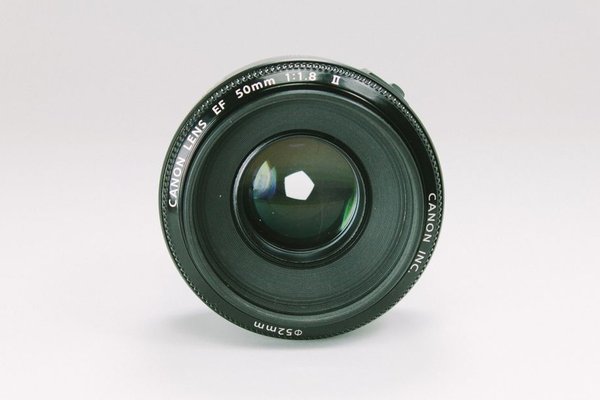
The f/1.8 printed on a lens barrel looks like a specification you should memorise, but it tells a surprisingly useful story. It suggests how much light the lens can gather, how easily it can blur a background and which shutter speeds might be practical indoors. Once camera aperture is explained in terms of ratios rather than mysterious numbers, lens listings and exposure settings become much easier to read.
What Aperture Actually Measures
Aperture is the opening through which light travels inside a camera lens. On many lenses, overlapping diaphragm blades enlarge or reduce that opening. A wider opening admits more light during a given exposure; a narrower one admits less.
Lens aperture is expressed as an f-number, such as f/2, f/4 or f/8. The number is calculated by dividing focal length by the diameter of the entrance pupil, the apparent opening viewed through the front of the lens. A 50mm lens at f/2 therefore has an entrance pupil approximately 25mm across. That is an optical measurement, not necessarily the physical diameter of the diaphragm blades.
F Stop Explained Without the Guesswork
The counterintuitive rule is that smaller f-numbers describe larger relative openings. At f/2 the lens is more open than at f/8. Think of the notation as a fraction: one-half is larger than one-eighth.
Aperture settings are often called f-stops, although a stop technically describes a doubling or halving of light. Photographers say “open up” when moving toward a lower f-number and “stop down” when moving toward a higher one.
Why the F-Stop Sequence Looks So Strange
The familiar full-stop sequence is f/1.4, f/2, f/2.8, f/4, f/5.6, f/8, f/11 and f/16. Each move to the right approximately halves the light admitted per unit of exposure time. Each move left doubles it.
The numbers change by roughly a factor of 1.4 because light-gathering area depends on the square of the opening’s diameter. Doubling an f-number reduces the opening’s area to one-quarter, or two full stops, rather than one-half.
Imagine photographing a still subject at f/4, ISO 400 and 1/250 second. Changing to f/5.6 would require approximately 1/125 second to keep the same brightness if the light and ISO stayed constant. You have traded one stop of light for a slower shutter. Many cameras also offer third-stop steps such as f/3.5 or f/4.5 for finer adjustment.
Depth of Field: What Aperture Changes in the Picture
Depth of field is the distance range that appears acceptably sharp around your focus point. A wide aperture such as f/1.8 generally creates a shallower range, which helps a portrait subject stand out against a soft background. A narrower aperture such as f/8 usually keeps more of the scene acceptably sharp.
That does not mean f/1.8 automatically produces creamy blur or f/11 makes everything sharp. Focal length, subject distance, background distance, sensor format and final viewing size also matter. Move a camera close to a flower and depth of field may remain thin even at f/8.
Smaller openings have a limit: at very narrow settings such as f/16 or f/22, diffraction can soften fine detail. More depth of field does not guarantee a sharper photograph overall. For a deeper explanation, explore the principles behind depth of field and focal length.
Lens Speed and the Numbers on a Lens Barrel
Lens speed does not refer to autofocus performance or how quickly a zoom rotates. A “fast” lens has a relatively wide maximum aperture, allowing a faster shutter speed at a given ISO and scene brightness. A 50mm f/1.8, for example, offers more light-gathering flexibility than a 50mm f/4 when both are fully open.
The maximum aperture is the widest setting the lens allows, not the setting you must use. An f/1.8 lens can usually be stopped down to f/4, f/8 and beyond. It cannot open wider than f/1.8.
Constant Versus Variable Maximum Aperture
A 24–70mm f/2.8 zoom maintains its advertised maximum f-number throughout its zoom range. A lens marked 18–55mm f/3.5–5.6 typically opens as wide as f/3.5 at 18mm but only f/5.6 at 55mm. That changing limit matters in dim light or when shooting in manual exposure mode.
How Aperture Works with Shutter Speed and ISO
Aperture changes the amount of light reaching the sensor per unit of time; shutter speed determines how long light is collected. ISO controls how the captured signal is represented in the image and affects the exposure setting you can use, but raising ISO does not make the lens collect more photons.
In aperture-priority mode, you select the f-number and the camera usually adjusts shutter speed for its metered exposure. Watch the resulting shutter speed when the light fades. Image stabilisation may help with hand shake, but it cannot freeze a moving child or pet. An introduction to shutter speed and ISO is a useful next read.
Why Video Lenses Sometimes Use T-Stops
F-numbers describe a geometric ratio, while T-stops account for actual light transmission through the glass. Some light is lost to reflections and absorption, so a lens set to f/2 may have a transmission rating around T/2.2, depending on its design.
Cinema lenses often display T-stops because consistent exposure matters when switching lenses during a shoot. For still photography, f-numbers remain the familiar language for aperture and depth-of-field decisions. The underlying principle is the same, even when the markings differ.
A Five-Minute Aperture Test
Place a mug on a table about a metre from the camera, with books or small lights several metres behind it. Keep the camera and mug stationary, focus on the same point and shoot in aperture-priority mode at f/2.8, f/5.6 and f/11, using a tripod if shutter speeds become slow.
Compare the background blur and note the shutter speed chosen for each frame. Because the camera compensates for changing aperture, overall brightness may look similar while depth of field changes noticeably. This exercise makes the relationship visible instead of leaving it as a lens specification.
Frequently Asked Questions
Is f/1.8 better than f/2.8?
Not universally. F/1.8 provides a wider maximum aperture and greater flexibility in low light, but f/2.8 may deliver the depth of field you want, and overall lens quality varies independently of the number.
Does a higher f-stop mean a brighter image?
No. With shutter speed and ISO held constant, a higher f-number means a smaller opening and a darker exposure. Automatic exposure modes may compensate by slowing the shutter or changing ISO.
Does crop factor change a lens’s f-stop?
A lens set to f/2.8 remains f/2.8 for exposure on different sensor sizes. Sensor format can change framing and depth-of-field comparisons when you adjust focal length or camera position to match the same composition.
What aperture should beginners start with?
Try f/4 or f/5.6 for general photography, then open wider for subject separation or stop down for more depth of field. Check the resulting shutter speed and review the image at full size.
Putting the Numbers to Work
Reading an aperture specification is ultimately about recognising trade-offs. Lower f-numbers offer larger relative openings, more light and often shallower depth of field. Higher f-numbers reduce light and usually increase the area that looks sharp. Combine that knowledge with the exposure triangle and a little practice, and lens labels become practical information rather than intimidating jargon.